
Checking for a Warrant in Georgetown County
For a Georgetown County arrest warrant, call the Sheriff's Warrants Unit first. A missed court date, traffic matter, or city ticket usually belongs to the court on the notice instead. Before you dial, gather your full name, date of birth, case or citation number, and the court date. The Sheriff's public page offers a phone contact rather than a searchable active-warrant list. A booking page only shows custody after service. The Trial Court Public Index can locate public case records. Still, a blank result does not settle warrant status.
- Read the ticket, summons, or court paper to identify the issuing court and case number.
- Call the Georgetown County Warrants Unit about a county arrest warrant and ask which court controls it.
- Search the South Carolina Trial Court Public Index for a public case or court event.
- For a traffic or city matter, contact the named magistrate or municipal court directly.
- If the record is unclear, ask the court about status, recall, bond, and the next hearing before acting.
Georgetown Has No Single Warrant Search
Georgetown County posts no public, countywide name search covering every warrant. The Sheriff's Warrants Unit manages and serves county arrest warrants, but its public page gives a phone number rather than a name-search form. The South Carolina Trial Court Public Index is a case-record gateway. It is not a full active-warrant roster. SLED CATCH sells a criminal-history report and expressly excludes Wanted Persons. South Carolina Information Exchange serves authorized users only. So the public route stays court by court. When online records do not answer the question, call the right Georgetown County office directly.
Search limit: A name that does not appear in an online case or booking result may still have an unserved, lower-court, sealed, or recently entered warrant.
Georgetown County Warrant Types
Georgetown County uses several kinds of court process. An arrest warrant follows a criminal charging process. A bench warrant follows a court event, such as a missed appearance or a contempt finding. Magistrate and municipal courts handle many local traffic and summary matters, while General Sessions handles circuit criminal cases.
| Type | How It Arises | Who Controls It |
|---|---|---|
| Arrest warrant | Sworn criminal information and judicial process | Issuing magistrate or circuit court; Sheriff serves county process |
| Bench warrant | Missed date, contempt, or failure to comply | The court that set the matter |
| Traffic warrant | Unpaid citation or missed traffic setting | Issuing magistrate or municipal court |
| Search warrant | Judicial authority to search or seize specified property | Issuing court; distinct from an arrest warrant |
South Carolina's own materials say "bench warrant," "arrest warrant," and failure to appear. "Capias pro fine" is not the standard Georgetown County label.
Georgetown County Magistrate Warrant Paths
The State Auditor's Georgetown County court-system report describes eleven court systems. Eight of those are magistrate courts. Those lower courts hear traffic and summary cases, giving a reader several separate places to ask about an FTA or bench warrant.
Georgetown County publishes no count of active warrants. These court counts describe the offices you may need to contact, not the number of warrants or people named in one.
Inside a Georgetown County Warrant Record
A public case record may show the court, case party, charge, case events, and hearing dates. Booking and Release adds custody fields after an arrest. Georgetown County publishes no public warrant-number format or universal status-code list. Ask the issuing office to explain an entry that reads unclearly.
| Warrant number | Format not published Ask the issuing court for its process number. |
|---|---|
| Case and court | The Public Index may show the court and case number for an available public case. |
| Charge | Booking pages may show a charge after the warrant has been served. |
| Bond | Bond information can appear after Bond Court paperwork reaches the Booking Officer. |
| Status | Local public status codes were not found; ask the court whether process is open, served, or recalled. |
Treat any expected field list loosely, since online records vary. Georgetown County court and booking systems serve different purposes.
Booking Is Not a Georgetown Warrant Check
The Sheriff's Booking and Release interface is a custody and release tool. It is not an outstanding-warrant list. Its form takes a name plus arrest or release dates. That can help a family member find someone already booked, but it cannot show every unserved warrant or every open city-court matter. The Sheriff FAQ says charges post after the warrant is served, and bond details appear after Bond Court paperwork reaches the Booking Officer. A Georgetown County warrant may exist before either item shows up. So a no-result here does not answer whether process is active. Call the issuing court for that.
| Interface | Useful For | Not a Substitute For |
|---|---|---|
| Booking and Release | Current or recent custody fields | Unserved-warrant confirmation |
| Trial Court Public Index | Public case and event details | Complete active-warrant status |
Issuing and Serving Warrants in Georgetown County
Courts issue process. Law-enforcement officers serve it. General Sessions is the circuit criminal court for serious cases, and the Georgetown County Clerk of Court keeps its circuit and Family Court files. The Clerk's counter does not hold every magistrate or municipal case. The Georgetown County Sheriff's Office Warrants Unit manages and serves county arrest warrants. Municipal police and magistrates' constables may handle city or summary-court process. The serving office can sit somewhere other than the court that controls recall or the next hearing.
Georgetown County Sheriff’s Office
430 N. Fraser Street
Georgetown, SC 29440
(843) 546-5102
The State Auditor's Georgetown County court report documents the county's court network. The South Carolina Judicial Branch page for Georgetown shows the courthouse and its court offices.
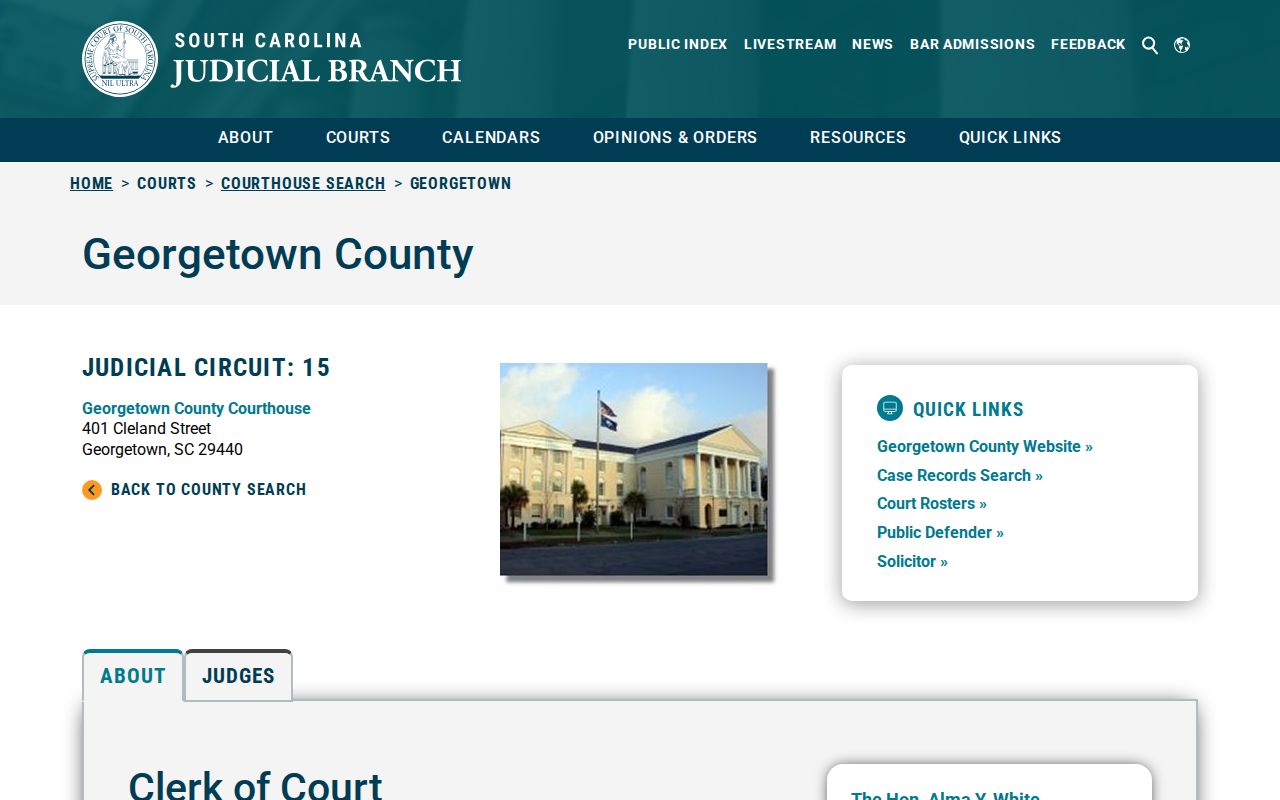
The directory lists Circuit 15, the Clerk, magistrate offices, Bond Court, and municipal judges. That spread shows why the issuing court matters in Georgetown County.
Georgetown County Offices Hold Different Warrants
A circuit case, a Family Court matter, and a city ticket rarely sit at one counter. The Clerk of Court holds General Sessions and Family Court records at the courthouse. A municipal court keeps city ordinance and ticket matters. A magistrate court handles assigned county summary cases. For a Georgetown County arrest-warrant question, the Warrants Unit is the sheriff's channel. Missed a municipal date? Call that city court first. Court staff can tell you whether to seek a reset, pay through an approved channel, ask a judge, or speak with counsel.
| Record | Start Here | Georgetown Detail |
|---|---|---|
| Circuit or Family case | Clerk of Court | 401 Cleland Street; circuit and family files |
| Summary or traffic case | Named magistrate court | Several regional offices serve the county |
| City ordinance or ticket | Municipal court | Andrews, Georgetown, or Pawleys Island |
If You Have a Warrant in Georgetown County
Start by confirming which court issued the warrant and which office holds it. That answer shapes everything else. If an arrest warrant seems likely, call the Warrants Unit or speak with a criminal-defense lawyer before you plan to appear. Georgetown County posts no general safe-surrender window. No office promises same-day release. A bench warrant may call for a different step, such as a new court setting, a payment, a judge's order, or a motion filed through counsel. The court sets any bond. Whatever happens, keep the underlying case date after any bond or payment, and get proof that the issuing court recalled or updated its process.
Act carefully: Do not pay an unsolicited caller or walk into a facility based on a phone demand; verify the court, status, and proper location through published office numbers.
- Gather the notice, case or citation number, and photo ID.
- Ask the issuing court what action is required and whether counsel should arrange an appearance.
- Confirm bond or payment details with the court or detention staff, then request written clearance information.
The detailed steps in the Georgetown County arrest-warrant search include the county's limits on walk-in visits and bond information.
Missed Dates Can Create Georgetown Bench Warrants
In Georgetown County, a missed setting can lead the issuing judge to order a bench warrant out of General Sessions, a magistrate court, a municipal court, or Family Court. The case file comes first. A sheriff booking page may show nothing until the warrant is served. Ask what the court wants. It could be a personal appearance. It could be a new date, a payment, a purge amount, or a request for recall. A ticket payment alone does not prove the bench warrant was withdrawn. The clerk may confirm the next step. If not, ask whether a lawyer should contact the judge or file a motion.
Process: missed date or order › issuing court reviews the case › process may issue › service, appearance, payment, bond, or recall updates the record.
Note: In Georgetown County, keep the receipt, and confirm the court updated its record before treating the missed-date matter as resolved.
Georgetown County Warrant Records and Public Access
South Carolina's Freedom of Information Act gives the public a right to inspect or copy records, within exemptions and reasonable access rules. The law still creates no public warrant roster. A law-enforcement record can be withheld or redacted. Disclosure might harm an investigation, expose a source, invade privacy, or endanger someone. Georgetown County court files can also be sealed. Juvenile court records and identifying information get separate protection. The Public Index holds only public material and may lag recent entries. Ask the specific court or public body for a non-exempt record and its current fee schedule.
Key rules:
S.C. Code §30-4-30 allows access to public records and sets request, fee, and response rules.
S.C. Code §30-4-40(a)(3) permits withholding certain law-enforcement records.
S.C. Code Title 63, Chapter 19 protects juvenile court and identifying records except as law allows.
The South Carolina Legislature publishes the FOIA text and its public-record categories.
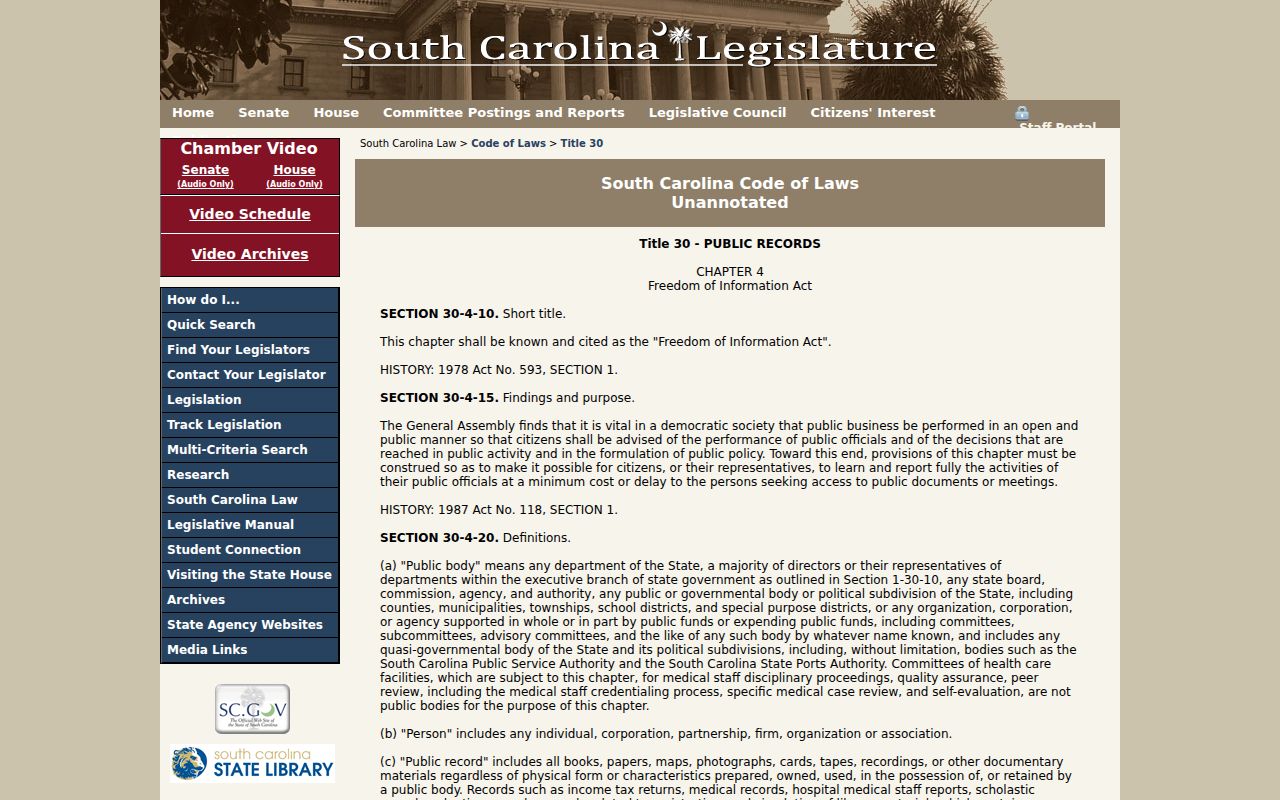
The statutory page spells out the inspection right. It also shows the limits that can apply to a warrant-related request in Georgetown County.
Georgetown County Warrants by City
Georgetown County has three incorporated municipalities with their own municipal courts and police channels. Georgetown is the largest. Andrews and Pawleys Island follow, per the 2020 Census figures documented by the Census Bureau. Their courts hear city matters. County magistrates handle separate summary cases. For a local missed date or ordinance matter, use the city court named on the ticket; a county arrest-warrant question still routes through the Sheriff's Warrants Unit or the issuing court.
Georgetown Warrant Search
8,403 residents, 2020 Census
City police request route and Georgetown Municipal Court handle city records.
Andrews Warrant Search
2,575 residents, 2020 Census
Andrews Police Department and Municipal Court share the North Morgan contact area.
Pawleys Island Warrant Search
130 residents, 2020 Census
Pawleys Island Municipal Court posts monthly sessions and ticket-payment rules.
The Census QuickFacts profile documents the Georgetown city count in Georgetown County, while Census Bureau profiles cover Andrews and Pawleys Island.
Georgetown County Warrant Scam Calls
Georgetown County officials warn that scammers may spoof a public employee's name or caller ID and demand money for a fake warrant. No real warrant is served by phone. Law enforcement will not ask a caller to send cash, wire funds, or gift cards. Hang up. Then find the Sheriff's published number on your own. Use the Warrants Unit for county arrest-process questions. Use the issuing court for a bench warrant, and 911 only for an emergency. The Sheriff's public home page and news archive carry the official county alerts.
Do not call back the number on a threatening message. Find the official court or Sheriff contact and verify the claim yourself.